
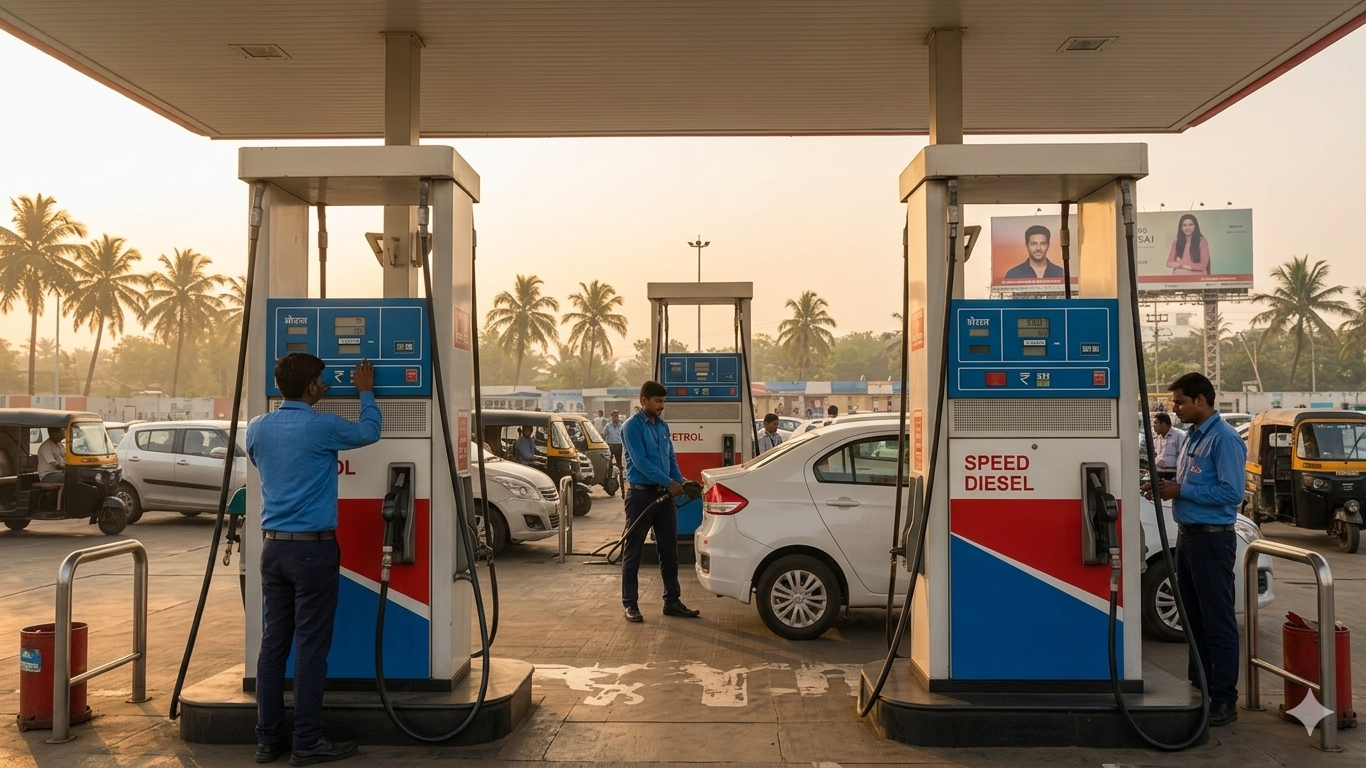
NEW DELHI: India’s state-run Oil Marketing Companies (OMCs)—which control nearly 90% of the domestic fuel retail market—hiked petrol and diesel prices by over ₹3 per litre each on Friday. While the move ends a historic four-year price freeze, analysts warn it is a mere drop in the ocean compared to the massive under-recoveries accumulated by these firms.
The widely anticipated price revision comes on the heels of a nearly 50% surge in global crude oil prices over the last four years, during which domestic retail prices remained completely unchanged despite mounting pressure.
A Drop in the Ocean of Losses
While the price hike offers incremental relief, market experts believe it is severely inadequate to nurse OMCs back to financial health. According to earlier estimates by the Oil Ministry, at prevailing crude prices, OMCs were incurring staggering losses of around ₹20 per litre on petrol and nearly ₹100 per litre on diesel.
On Friday, international benchmarks saw further gains, with Brent crude futures trading 1.66% higher at $107.48 per barrel, and US West Texas Intermediate (WTI) crude rising 2.01% to $103.20 per barrel.
“Indian Oil Corporation (IOC), Bharat Petroleum Corporation Ltd (BPCL), and Hindustan Petroleum Corporation Ltd (HPCL) were together incurring under-recoveries of ₹1,600–1,700 crore per day by selling fuel below cost,” said market veteran Sunil Subramaniam. “The cumulative under-recovery for the quarter alone is expected to surge to nearly ₹2 lakh crore, with losses of around ₹1 lakh crore.”
Subramaniam emphasized that structural stress on the sector will persist as long as Brent crude remains stubbornly above the $100 per barrel mark.
The Financial Impact: By the Numbers
Dhaval Popat, Energy Analyst at Choice Institutional Equities, broke down the financial math of the hike:
- Per Rupee Impact: Every ₹1 per litre increase in fuel prices improves the annualized EBITDA of the three PSU OMCs combined by roughly ₹15,000 – ₹16,000 crore.
- Current Hike Benefit: The ₹3 hike will translate into an annualized earnings benefit of ₹45,000 – ₹48,000 crore.
- The Deficit: Against an estimated industry-wide loss running at nearly ₹1 lakh crore monthly, this hike offsets only a fraction of the earnings erosion.
Rating agency ICRA further highlighted that even after this hike, OMCs continue to lose nearly ₹500 crore per day on the sale of auto fuels and domestic LPG, factoring in a $105–110 per barrel crude range and 10-year average crack spreads.
Is More Pain at the Pump Ahead?
Analysts broadly agree that this ₹3 hike is just the beginning of a longer calibration.
Jahol Prajapati, Equity Research Analyst at SAMCO Securities, noted that while the hike improves near-term earnings visibility and investor sentiment, “further calibrated hikes may still be required to fully restore retail margins.” Prajapati estimates that an overall hike of ₹10–15 per litre may ultimately be needed to normalize profitability.
Popat added that a total rise of ₹10 per litre overall (including Friday’s ₹3 hike) would be required just to offset current losses, unless global crude prices correct sharply or the government steps in with compensation measures.
However, from a market perspective, the worst might be over for OMC stocks. Saurabh Jain, Head of Fundamental Research at SMC Global Securities, noted: “The key positive is that concerns around prolonged margin stress and balance sheet pressure on OMCs could now start easing. Investors may now focus again on core fundamentals like refining margins and inventory gains.”
Macro Impact: Mild Inflationary Pressures
While the hike hurts the consumer’s pocket, economists believe the immediate shock to headline inflation will be manageable, though second-order effects warrant caution.
Estimated Impact on CPI Inflation:
- Sunil Subramaniam: Anticipates a modest direct impact on CPI inflation in the range of 10–15 basis points.
- Radhika Rao (Senior Economist, DBS Bank): Estimates that given the weightage of fuel in the CPI basket, a 3–5% increase could add 15–25 basis points to headline inflation, excluding second-round effects.
The real concern, however, lies with diesel. “Diesel is widely used in goods transportation, agriculture, and commercial vehicles,” Subramaniam explained. “Even a ₹3 per litre increase could raise freight and farm input costs, exerting mild upward pressure on food inflation—particularly for vegetables and other perishables—over the next four to eight weeks.”












Leave a comment