
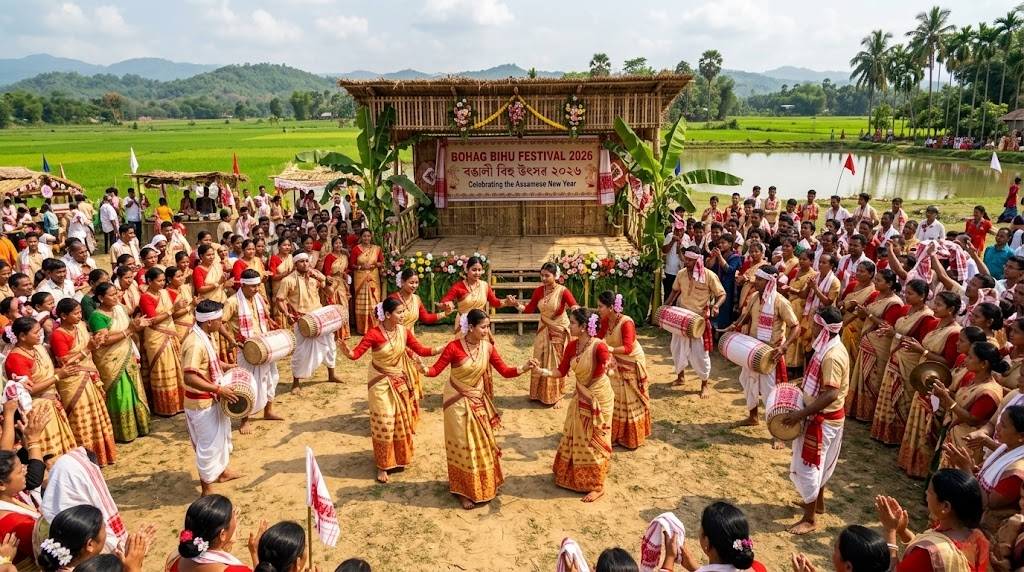
When the first showers of April touch the thirsty earth and the Kapou Phool (Foxtail Orchid) begins to bloom in shades of lavender, a rhythmic pulse takes over the heart of Assam. This is Rongali Bihu—also known as Bohag Bihu—the festival of merriment, the herald of the Assamese New Year, and a soulful tribute to nature’s renewal.
More than just a single day, Rongali Bihu is a multi-day journey that honors every element of Assamese life. It begins with Goru Bihu, where the community pays homage to its livestock. Cattle are brought to the riverbanks, bathed with a paste of turmeric and black gram, and gently whipped with sprigs of makhiyati for good health. It is a humble reminder of the deep connection between the farmer and the land.
As the new year officially dawns, the focus shifts to Manuh Bihu. This is a time of deep respect and social harmony. Generations gather to seek blessings from their elders, offering the Gamosa—a hand-woven white cloth with red borders—as a symbol of love and identity. The air becomes heavy with the scent of fresh clothes and the anticipation of the festivities to come.
The days that follow, including Kutum Bihu and Senehi Bihu, are dedicated to kinship and the bonds of the heart. Families travel across villages to share meals, ensuring that no house is left without a visitor and no guest is left without a treat.
A Symphony of Rhythm and Taste
The soul of the festival lies in the Bihu Dance. Young men and women, dressed in shimmering Muga silk Mekhela Chadors and Dhotis, perform to the high-pitched calls of the Pepa (buffalo hornpipe) and the deep, resonant beats of the Dhol. The movements are energetic and fluid, mimicking the sowing of seeds and the blooming of flowers.
No Bihu story is complete without the flavors of the kitchen. The hearths of Assam work overtime to produce an array of traditional delicacies:
- Pitha: Delicate rice cakes filled with sweet sesame or coconut.
- Laru: Golden sweet balls made of coconut or jaggery.
- Jolpan: A comforting breakfast of cream, curd, and puffed rice that fuels the dancers for their long performances.
Today, while the rural fields remains the spiritual home of Bihu, the festival has found a grand stage in urban centers. From the historic grounds of Guwahati to digital screens across the globe, the essence remains unchanged. Whether it is the twang of a Gogona (bamboo jaw harp) or the shared laughter over a plate of Larous, Rongali Bihu is a reminder that no matter how fast the world moves, the rhythm of spring always brings the community back together.
“Bihu is not just a festival; it is the lifeblood of the people, as ancient and eternal as the Brahmaputra itself.”














Leave a comment