
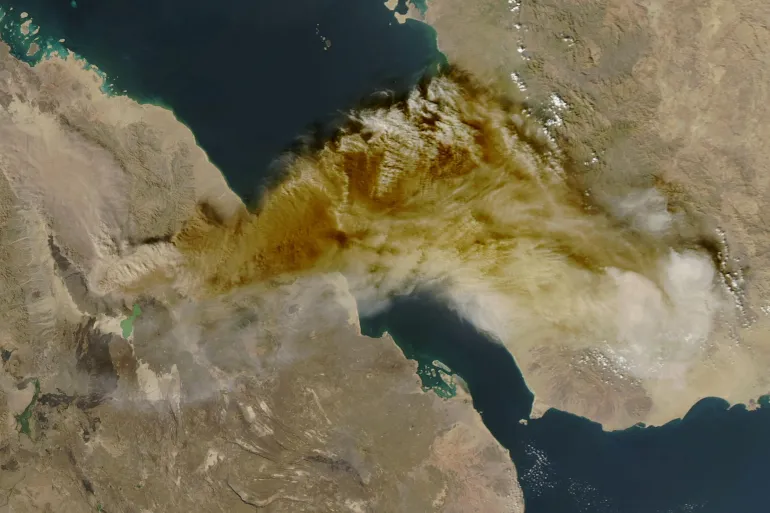
The Hayli Gubbi volcano in Ethiopia’s remote Afar region roared back to life on Sunday, spewing a massive column of ash nine miles (14 km or 45,000 ft) into the sky. The eruption marks the first known major activity from the long-dormant volcano in an estimated 10,000 to 12,000 years, since the end of the last Ice Age.
The shield volcano, located in Ethiopia’s arid, rural northeast and part of the Erta Ale Range, erupted explosively, generating a powerful “shock wave” that was felt by local residents.
- Local Impact: “It felt like a sudden bomb had been thrown, with smoke and ash,” said Ahmed Abdela, a resident of the Afar region, according to AP. The nearby village of Afdera was blanketed in thick volcanic dust, stranding tourists and guides.
- Volcanic Plume: The towering ash column was visible from satellites and immediately began drifting eastward across the Red Sea towards Yemen and Oman.
Global Flight Disruption as Ash Drifts East
The high-altitude ash plume has rapidly travelled thousands of kilometers across the Arabian Sea, causing significant disruption to air travel across the region, including India.
- Aviation Alert: Volcanic ash poses a severe threat to jet engines, as the fine, abrasive particles can melt and solidify on turbine blades. Aviation regulators, including India’s Directorate General of Civil Aviation (DGCA), have issued advisories instructing airlines to strictly avoid the affected flight corridors.
- India Impact: Ash clouds impacted flight operations in India on Monday, leading to reroutings and cancellations of several flights, particularly those on international routes to the Middle East. Forecast models indicated the ash influence extended over Gujarat, Delhi-NCR, Rajasthan, Punjab, and Haryana on Tuesday.
- IMD Forecast: India Meteorological Department (IMD) Director General Mrutyunjay Mohapatra confirmed the ash cloud is drifting towards China and is expected to move completely away from Indian airspace by 7:30 pm on Tuesday.
Clue to Undetected Ancient Eruptions
The sudden awakening of the volcano has captured the attention of the scientific community, as Hayli Gubbi has no recorded eruptions in the Holocene period (the last 12,000 years).
Juliet Biggs, an earth scientist at the University of Bristol, suggests the towering ash column may be a key clue. The under-studied volcano’s activity could indicate other, previously undetected eruptions occurred during its long period of presumed dormancy, highlighting the need for further research in the region.











Leave a comment